
University College London
Course code:
1900
Course length:
3 years (full-time)
Phone:
You can email any enquiries after checking all 6 pages below, which cover most FAQs. Home fee admissions enquiries: [email protected] or Self-funded non-home fee admissions enquiries: [email protected]

Overview
Who can apply:
You must have eligibility for GBC confirmed at time of application.
You must not be formally registered (or re-sitting exams) for another qualification at the start of our programme (usually the penultimate or last week in September).
You must not violate the NHSE 2-year funding rule policy.
Please see our UCL Entry Requirements page for details.
Qualifications:
High 2:1 (67% or above) in the degree that gives you eligibility for GBC.
If you do not have a high 2:1 please see our UCL Entry Requirements page for mitigating circumstances and/or postgraduate study.
Experience:
At least 12 months FTE relevant clinical experience, with at least 6 months paid.
Please see our UCL Entry Requirements page for details.
Residence:
For NHS-funded places you must have Home Fee status.
For self-funded places you must have Overseas Fee status.
Please see our UCL Entry Requirements page for details.
Application:
We do not have any additional tests as part of short-listing.
Disability:
We do not participate in the Disability Confident scheme.
Document requirements:
Please see our UCL Entry Requirements page for details about providing the "final overall percentage grade" letter.
Please use the Download Application option (from Overview) to check that all your uploaded documents are visible and legible in the application PDF.
Please provide a document confirming your GBC status, plus:
- Undergraduate degree TRANSCRIPT
- Conversion course TRANSCRIPT (if completed)
- Any other Masters degree TRANSCRIPT (if completed)
- Any other Postgraduate degree TRANSCRIPT (if completed)
- If the transcript for your GBC course (undergrad or conversion) does not give a final overall percentage grade, please provide a letter from the course giving this grade
Professional accreditation
This course is accredited by the:
- Health and Care Professions Council (HCPC)
- British Psychological Society (BPS)
Trainees completing the course will also receive:
- Recognition of having completed a Foundation level course in Systemic Thinking and Practice accredited by the Association for Family and Systemic Psychotherapy (AFSP) if they successfully complete the DClinPsy course and course work required by the ASFP.
- Eligibility to use CBT clinical hours and supervision gained across DClinPsy placements to apply for accreditation as a CBT practitioner with the British Association for Behavioural and Cognitive Psychotherapies (BABCP) via the individual route post qualification.
The course also offers four pathways:
BABCP-accredited CBT Pathway
All trainees on the programme receive a thorough training in CBT. We also offer a BABCP accredited CBT pathway at Level 2 . Trainees who complete this CBT pathway will be eligible to apply for BABCP accreditation when they complete their DClinPsy. There is a selection procedure as only a proportion of trainees can follow this pathway and trainees are asked to indicate their interest prior to joining the course, once they have considered the additional academic and clinical requirements of the pathway. This is our largest pathway with typically around a third of trainees enrolled.
Intermediate Systemic Pathway
All trainees on the programme receive teaching on the fundamentals of systemic theory and practice, and are able to opt into our embedded Foundation Course in Systemic Thinking and Practice by completing a systemic essay and a reflective log. We also have a small number of trainees (currently up to eight in each cohort) on our intermediate systemic pathway, for which we are seeking accreditation with the Association for Family and Systemic Psychotherapy (AFSP) over summer 2026. Trainees on the pathway are required to complete additional teaching hours and assessments, in addition to completing at least one placement with a systemic orientation. Trainees are given more information about the pathway and the selection procedure for the pathway during year 1.
Neuropsychology Pathway
The pathway does not lead to an independent accreditation but its completion will be noted on the graduation letter from UCL. Trainees who complete the pathway will be able to:
- count up to one year of supervised practice done on the DClinPsy towards a two-year post-doctoral qualification in clinical neuropsychology;
- skip some of the learning component on the Bristol post-doctoral course in clinical neuropsychology;
- leave with additional learning and experience in neuropsychology.
The pathway requires trainees to do two pieces of neuropsychology-related coursework, select a neuropsychology placement, and attend additional teaching. Again, there is a selection procedure for the pathway and only a small number (approximately 6 trainees in each cohort) are able to pursue the pathway. Trainees receive more information about the pathway and the selection procedure in the first or second term of the course.
Clinical Academic Pathway
The clinical academic pathway aims to give research-focused trainees additional opportunities throughout their training to learn more about clinical academic careers, with an aim of applying for competitive research funding post-training. There is no formal accreditation for this pathway, but the goal is that by the end of training, pathway trainees will have solidified their further research plans and will be preparing to submit an application for further clinical academic work (e.g., PhD, fellowship, clinician scientist role).
The pathway begins with semi-regular meetings and workshops in Year 1, and evolves into more independent, hands-on research experience (beyond the major research project) as training progresses. Trainees can expect regular meetings of an hour each, as well as group and self-led activities (i.e., research presentations and interactive feedback, working with or shadowing other clinical academics at UCL), and most "assignment-based" deadlines are aligned with standard course deadlines (e.g., research project proposal submission). Trainees are also given preference for clinical academic placements in Year 3. These aim to build additional research and leadership skills, as well as to broaden experience of clinical research (including trials and other studies), and to help trainees widen their research networks. Again, there are a relatively small number of places on the pathway (5 to 10 trainees) and trainees are given more information about the pathway and the selection procedure in the first or second term of the course.
Approach and theories
The core purpose of the course is to train compassionate and culturally humble reflective scientist-practitioners who are able to engage with multiple perspectives. This includes exposing trainees to a variety of clinical approaches and theories, including the following:
- Cognitive behavioural therapy including third wave models ACT and CFT
- Systemic
- Psychodynamic
Placement locations
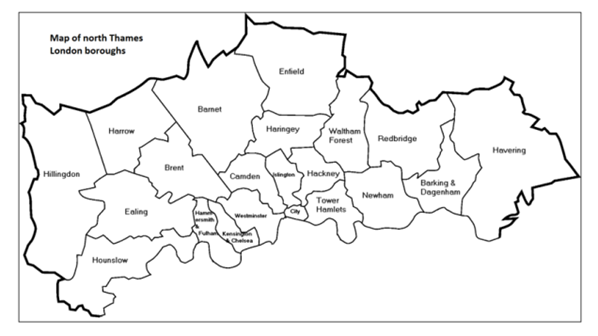
- Trainees are expected to travel to placements within the North Thames region (see the list and/or the map below)
- Placements are in a range of NHS Trusts and third sector organisations.
- Commute times can be anywhere up to 1 hour 30 minutes one way, though we do try to ensure trainees have a mix of commute length across the course. If you live outside of the North Thames region, your commute may exceed 1 hour 30 minutes one way.
- Placement allocators take into account any additional needs that have been agreed with course tutors e.g. relating to childcare / caring responsibilities, mental and physical health issues.
- Placements are primarily in person although some may involve hybrid working.
Here is a list of the of the boroughs the placements may be in:
Barking and Dagenham, Barnet, Brent, Camden, Ealing, Enfield, Hackney, Hammersmith and Fulham, Haringey, Harrow, Havering, Hillingdon, Hounslow, Islington, Kensington and Chelsea, Newham, Redbridge, Tower Hamlets, Waltham Forest, Westminster, City of London. [Note: This list may be amended as required].
And here is a geographical map of the boroughs
Last updated:
7th September 2026